For a while now, I have been looking at various pell designs and wondering what might best fit my use case and constraints. Cutting and thrusting motions can be trained in the air, and this is even better in some respect than striking a fixed target because the footwork can be more varied. However, when you only have air in front of you, you never have the constraints of controlling your distance and aiming at the exact right spot. You can’t miss with a cut or thrust that is done in the air. That feedback between an actual target and your motion is one pretty irreplaceable function of a pell which you cannot train solo in any other way. This is the function of a pell that I missed the most, and was ending up trying to emulate (without contact!) pretty much every time I was training near something vaguely vertical: wall, open door, drapings, trees… I wanted to have something to strike and thrust at, not necessarily hard, mainly to work on precision. I also wanted it to work inside or outside, yet not become a permanent fixture in my house or backyard.
The idea that appealed to me the most is one of the simplest: a tennis ball hanging on a rope. This is a common suggestion for a thrusting target. It is indeed a pretty good size for this purpose, and it’s even tempting for cuts: striking a ball does seem like it would work, they are made for this!
However the simple hanging ball design does not work well at all for cuts. While thrusts are relatively slow moving, cuts generate a lot more force, and so the ball will be bouncing all over the place, preventing a quick succession of attacks (and making it risky for anything in range!). For near vertical cuts that strike almost along the cord, there is the reverse problem: the impact forces are just getting transmitted straight through the cord, into the mount point. Make it solid enough, and you are striking an unyielding target, which will inevitably end up damaging the pell, the weapon or the mount point.
A single ball is also not very varied: you hang it a certain height, it’s there, end of story. But not all the strikes target the same place!
Building it
With these issues in mind, there were three improvements I could see:
- hang several balls instead of just one
- reduce oscillations by anchoring into the ground
- add some vertical give, by using elastic ropes
I have chosen to put three balls for that first iteration, as it seemed to be the minimal number providing enough variety in targets: one at head height, the second at lower chest, the third just above the knee (these are basically the targets in canne de combat, except the knee is a bit high). For myself, in an on-guard position, this gives roughly 40cm between head and chest, 60cm between chest and knee, and 60cm between ground and knee.
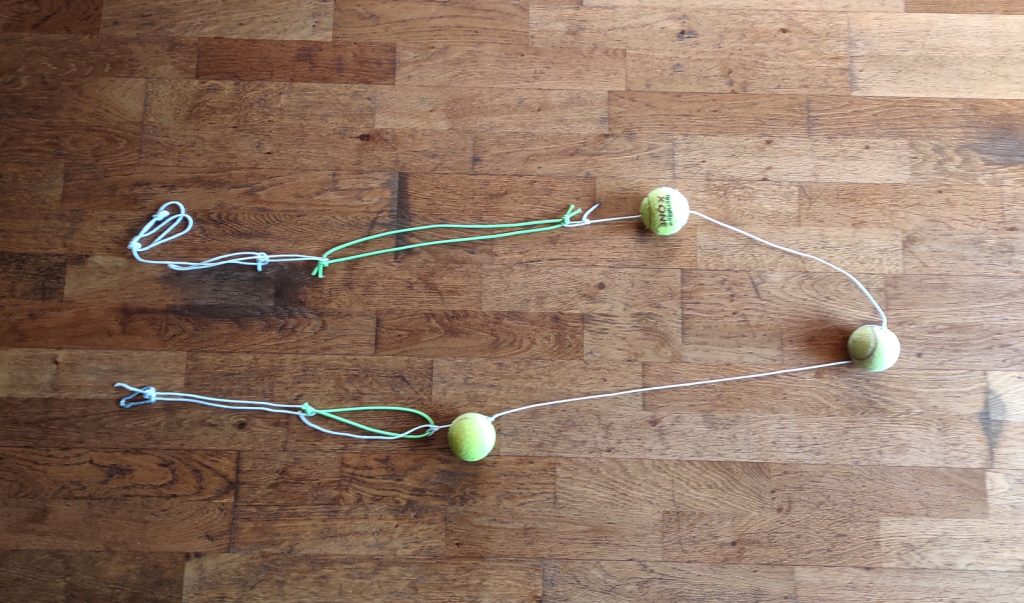
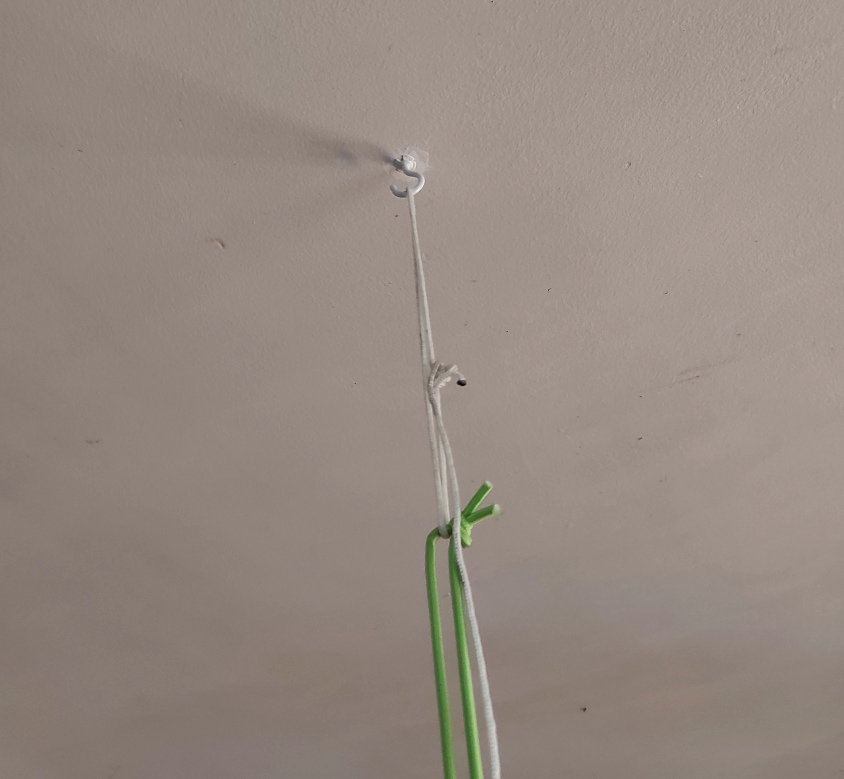
Piercing the balls was perhaps the most difficult part, I did this with a dagger. Then I threaded a piece of string through all three balls with two bowlines knots at either end. Through these bowlines I passed two 4mm sandow loops, one 40cm at the top and one 20cm at the bottom. These are providing the vertical give that I was looking for. Finally, two loops of string at either end reach the fixation points. I’ve left the top one adjustable to keep the possibility of fixing this in various places.
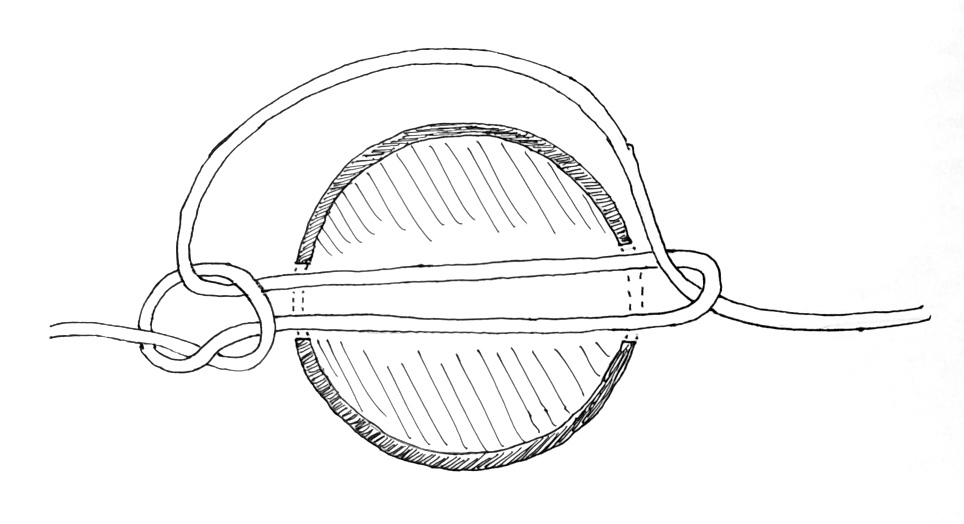
In order to have better control over the positions of the balls on the string, I have used a noose knot. I feed the noose through the ball using a chopstick, and then pass the loose end through the noose and tighten. The knot at the top does not move, making it easier to measure and keep distances between the balls.
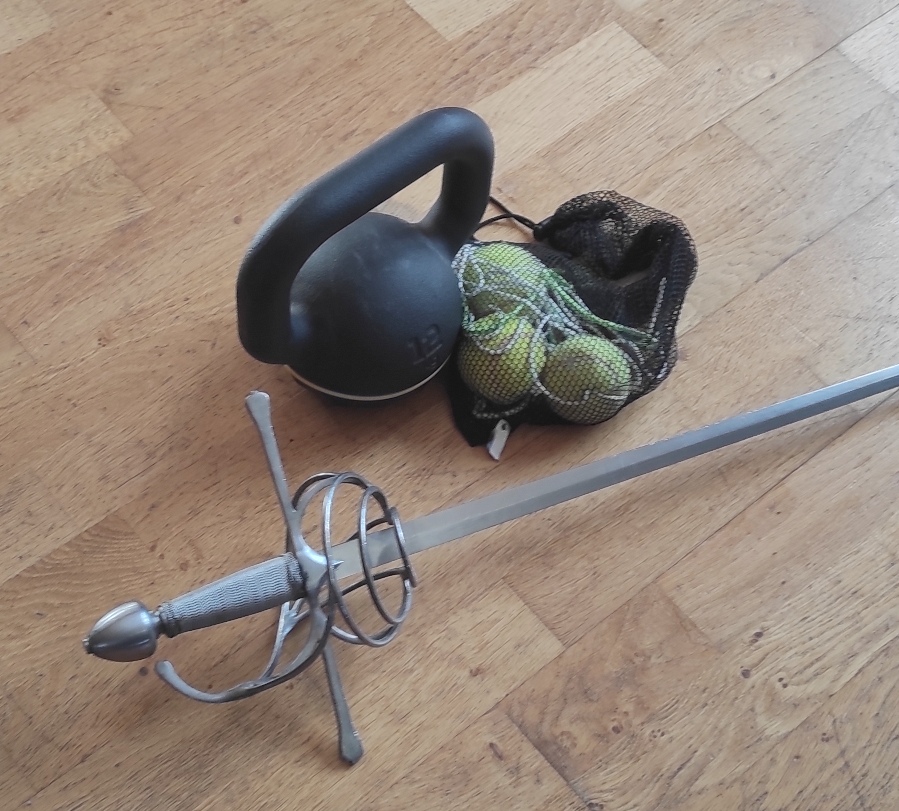
I have picked a 12kg kettlebell as the bottom anchor. It’s a little bit overkill for the purpose, I guess anything up from 4kg would work. There are many possible choices here. And here is the final thing hanging from a tree branch:
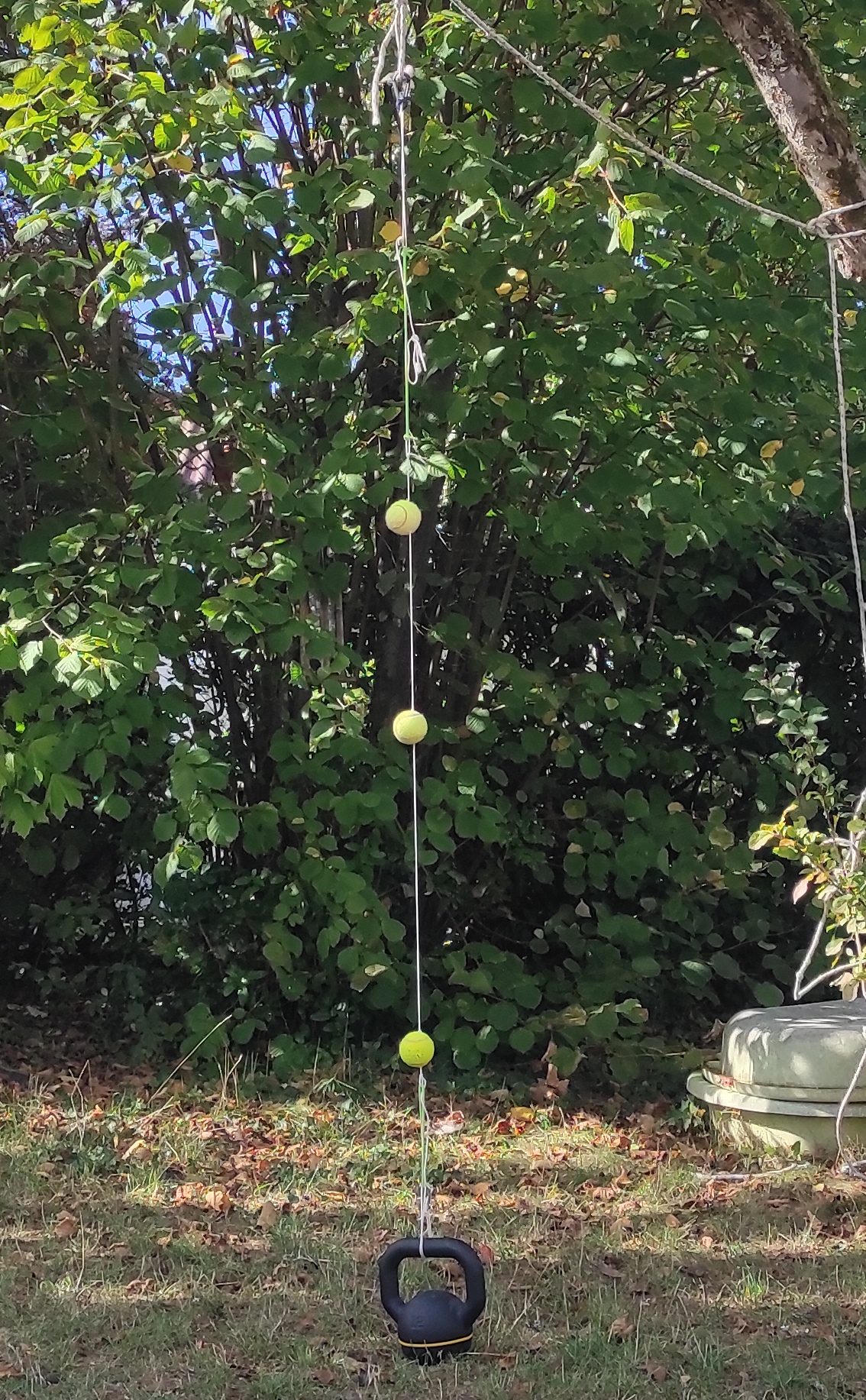
This turned out to be an even better pell than I expected!
Playing with it
Here I am trying it out with my boken and a variety of cuts and thrusts. Not a HEMA weapon, but it does pack a punch and I wanted to show how the pell reacts to it. I have tested this target with basically everything I have: bare-handed, dagger, canne, boken, rapiers, two-handed sword, naginata… It works with everything.
I am far from hitting the balls dead-on with each and every strike! In the video you can hear the difference. They are somewhat challenging targets, especially when they move, but one quality I did not expect is that they provide feedback. You feel when you hit them flush, you know when you miss and hit the cord. They do not seem to put undue stress on training weapons. The whole assembly does not to suffer at all from the hits, apparently. Very little shock goes back to the hanging point because the elastic loops absorb the impact. The branch it is hanging on in the video is not budging. Therefore, it can also be hung inside with a relatively flimsy hook in the ceiling, with no need to find a stout beam or stuff like that. It is extremely compact to store (even taking the kettlebell into account) and fairly easy to carry around.
Of course you cannot hit fully through this, especially with long weapons, as you get tangled. The pell weathers full blows and is perfectly fine with full thrusts but works best for controlled cuts. That is a constraint of most pell designs anyway, unless you are cool with ruining your weapons, your pell, or both. It is not a heavy bag; you cannot train the transfer of force into the target because the balls are very light. You still feel the impact, but especially with bare hands you definitely feel the difference with an actual body. For sword simulators, I do not miss this so much. In some way it is comparable to the feedback I get when cutting through green bamboo: the blade slows but is not stopped.
I am really satisfied with the versatility of this design, relative to how easy it was to make. I can throw pretty much any attack combination with any sort of weapon. I do not need special pell training weapons; I can just pick up whatever trainer I want and it works.
It is not 100% perfect:
- I would enjoy having several targets at different “depths”, rather than all fixed on the same vertical
- As it stands, it still favors horizontal blows somewhat, because the balls tend to oscillate more on an horizontal plane, and so chaining many horizontal strikes is relatively easy, whereas chaining diagonal strikes can be much more challenging.
I can see ways to make it more complex and solve some of these issues, but I really enjoy the utter simplicity of the design and the fact that it takes the storage space of three tennis balls, basically.
I will see how durable this ends up being. So far it is holding up fine, but it’s only been a month. Maybe I will find some weak points. My first suspicion is that the balls might eventually split under the tension in the string, the way I have attached them. The dagger I used has made a cut instead of a round hole, so at either end there is a possibility for the crack to propagate. Or maybe the cord or the sandows will give in first. Anyway, the thing can hardly be beaten for cost, so even if I end up having to rebuild it sometimes, it is not the end of the world!


